
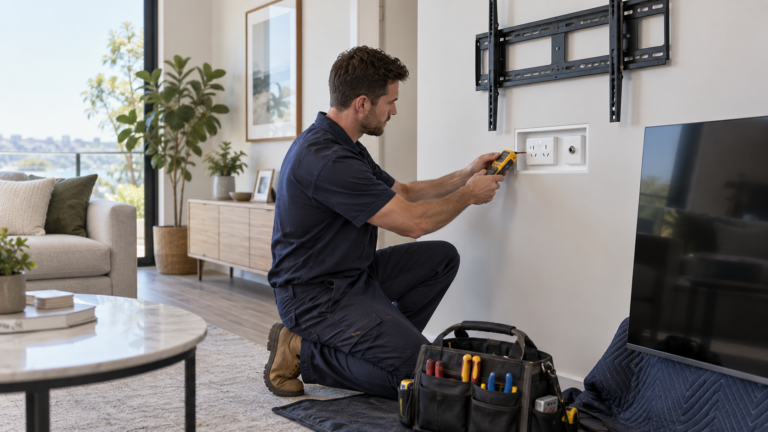


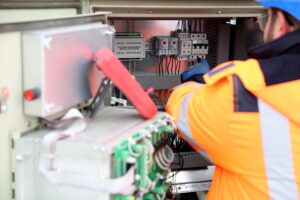

A TV point is a fixed wall outlet that connects your television to an antenna or signal distribution cable, usually via coaxial cabling run inside the wall or roof space. Homeowners typically need TV point installation when mounting a television on a new wall, adding a TV to another room, replacing cables that run visibly across the floor, or renovating a living area. The job may involve more than just the antenna outlet. A complete setup may also need a mains power point behind the screen, a data connection for a smart TV, a wall bracket, and cable concealment so nothing hangs down the wall. What it costs depends on the wall type, the cable route, whether roof access is needed, the condition of the existing antenna system, and whether electrical or data work is bundled into the job. A TV point is a fixed wall outlet that connects a television to an antenna or signal distribution cable, usually via coaxial cabling installed in the wall or roof space.
What Is a TV Point and When Do You Need One?
A TV point is normally an antenna or coaxial outlet fixed to the wall. It allows a television to receive free-to-air broadcasts from the property’s antenna or signal-distribution system, rather than relying on a long cable trailing to the nearest existing outlet. A TV point is not the same as:
- A mains power outlet
- A data or Ethernet outlet
- An HDMI wall plate
- A pay-TV or satellite connection
- A streaming device
Homeowners commonly install a new TV point when:
In This Guide
- What Is a TV Point and When Do You Need One?
- How Much Does TV Point Installation Cost?
- What Factors Affect the Cost of Installing a TV Point?
- What Should You Expect During TV Point Installation?
- Why Should You Hire a Licensed Electrician?
- What Should Be Included in a TV Point Installation Quote?
- When Is a TV Point Not the Best Solution?
- Get a Free Quote for TV Point Installation
- Frequently Asked Questions
- Mounting a television on a different wall
- Adding a TV to a bedroom
- Removing visible antenna cables running across a room
- Renovating a living room
- Converting a spare room into a media area
- Relocating an existing television
- Replacing a damaged or poorly positioned outlet
- Connecting another television to the existing antenna
- Combining antenna, power and data connections behind a wall-mounted TV
Connection Types Table
| Connection | Purpose | Common Use |
|---|---|---|
| TV antenna point | Connects the television to an antenna system | Free-to-air television |
| Power point | Supplies mains electricity | Television, soundbar and streaming devices |
| Data point | Provides a wired network connection | Smart TV streaming and software updates |
| HDMI connection | Carries digital audio and video | Connecting equipment in another cabinet |
| Pay-TV or satellite point | Connects compatible subscription equipment | Satellite or subscription television |
A smart TV does not necessarily remove the need for an antenna point. Streaming relies on an internet connection, while free-to-air reception still depends on an antenna system. Many Sydney households end up wanting both, particularly if they watch live sport or news alongside streaming apps.
How Much Does TV Point Installation Cost?
TV point installation costs depend mainly on the cable route, wall construction, site access, and whether a usable antenna signal already exists at the property. A simple point near an accessible cable run costs less than one that needs roof access, masonry drilling, or a new electrical circuit. Monaco Electrical’s complete TV installation service, covering mounting, TV point installation, power point installation and in-wall cable concealment in a single visit, is quoted from $150 for straightforward jobs. A new power point extending an existing circuit typically adds to that figure. These are starting points for common scenarios; the final price always depends on the specifics of your property, and a standalone TV point with no mounting or bundled work may be quoted separately.
TV Point Cost Factors Table
| Type of Work | Relative Cost | Additional Work | Indicative Total |
|---|---|---|---|
| Full installation (mounting and TV point), accessible cable route | Lower | Usually minimal | From $150, confirmed on quote |
| New point requiring roof-space cabling | Medium to high | Roof access and extra cable | Project dependent |
| Relocation of an existing TV point | Medium | Wall repair may be separate | Project dependent |
| TV point in a double-brick or concrete wall | Medium to high | Additional drilling or surface conduit | Project dependent |
| TV point with a new power outlet | Medium | Licensed electrical work | Confirmed on quote |
| TV point with data cabling | Medium to high | Registered cabling work | Project dependent |
| Antenna fault investigation | Medium | Repairs may be additional | Project dependent |
| Multi-room distribution | High | Splitters, amplifier or new cabling | Project dependent |
These are relative cost weightings, not fixed prices, since actual amounts depend on the specific job. A quote should state clearly whether it includes:
- GST
- Call-out fee
- Cable
- Wall plate and connector
- Labour
- Roof access
- Signal testing
- Cleanup
- Electrical work
- Data cabling
- Wall patching or painting
All prices above are indicative starting points, not fixed quotes. A site-specific assessment confirms the cable route, wall type, signal quality and final cost for your property. If you would like an accurate figure, get a free quote or call 1300 092 853 rather than relying on general online estimates that vary widely by source and location.
What Factors Affect the Cost of Installing a TV Point?
Installation complexity usually has a bigger effect on price than the wall plate itself. A short, accessible cable run in a plasterboard wall is a very different job from a concealed run through a double-storey, double-brick property. Cost factors include:
- Distance from the existing antenna cable
- Number of new TV points
- Single-storey or multi-storey property
- Roof-space accessibility
- Wall material (plasterboard, brick or concrete)
- Insulation and fire barriers
- Condition of the existing cable
- Antenna signal quality
- Whether splitters or amplifiers are needed
- Concealed versus surface-mounted cabling
- Power-point installation
- Data-point installation
- TV wall mounting
- Cable concealment
- Furniture or appliance access
- After-hours work
- Wall repairs and painting
Cost Impact Table
| Cost Factor | Why It Matters | Likely Cost Impact |
|---|---|---|
| Short accessible cable route | Requires less labour and cable | Low |
| Limited roof access | Makes routing and testing more difficult | Medium to high |
| Double-brick or concrete wall | May require specialised drilling or conduit | Medium to high |
| Multi-storey property | Creates longer and more complex cable routes | High |
| Weak existing signal | May require antenna testing or upgrades | Medium to high |
| Multiple points | Requires additional cable and signal planning | Medium |
| New power point | Adds regulated electrical work | Medium |
| New data connection | Requires compliant communications cabling | Medium |
| Concealed wall cabling | Requires suitable wall cavities and access | Medium |
| Patching and painting | May require another trade | Low to medium |
Splitting a single antenna signal across several televisions can weaken the signal at each outlet. A competent installer tests the existing system before adding a splitter or amplifier, rather than assuming one is needed.
What Should You Expect During TV Point Installation?
A straightforward TV point installation is often completed in a single visit. Complex cable routes, antenna faults, or jobs combining electrical and data work can take longer, and may need a site visit before a fixed price is confirmed. A typical installation follows these steps:
- Discuss the proposed television location.
- Inspect the existing antenna and outlets.
- Test the available signal where necessary.
- Check the proposed wall and cable route.
- Identify nearby power and data requirements.
- Confirm whether cabling can be concealed.
- Isolate electrical circuits if mains work is involved.
- Run the required cable.
- Install and terminate the wall outlet.
- Complete any approved power or data work.
- Test the finished connection.
- Clean the work area and explain the setup.
A competent installer avoids unnecessary cable joins and keeps antenna, communications and electrical cabling properly separated inside the wall. Before the visit, it helps to:
- Decide where the television will be positioned.
- Confirm the approximate mounting height.
- Clear furniture from the work area.
- Provide access to the switchboard and roof-space entry.
- Identify any known pipes or cables in the wall.
- Confirm whether the television will use free-to-air broadcasts.
- List the streaming devices, consoles and sound equipment you plan to connect.
- Decide whether visible conduit is acceptable.
- Ask whether wall patching and painting are included.
- Check whether the quote includes signal testing.
- Confirm who will reconnect and test the television afterwards.
Why Should You Hire a Licensed Electrician?
Any new or altered fixed mains wiring in NSW must be carried out by someone holding the appropriate electrical licence or certificate. The NSW Government’s electrical compliance guidance states that an electrical licence is required before undertaking any electrical wiring work in the state, regardless of the cost or type of work involved. A TV point project can involve several different regulated activities, not just one:
Regulated Work Table
| Work Required | Appropriate Qualification |
|---|---|
| Installing or moving a mains power point | Licensed electrician |
| Altering fixed electrical wiring | Licensed electrician |
| Installing regulated communications or data cabling | Appropriately registered cabler |
| Installing a basic antenna outlet | Suitably qualified antenna or cabling technician, depending on scope |
| Installing both the TV and the power outlets | Licensed electrician, plus any cabling registration required for the communications work |
| Mounting a television without changing wiring | Competent installer, subject to wall and bracket requirements |
An electrical licence does not automatically cover all communications cabling competencies. In NSW, telecommunications and data cabling work must be carried out under the ACMA Cabling Provider Rules, which require a registered cabler to perform this type of work and to certify that it complies with the relevant wiring standard. Ask your installer to confirm the scope of their licensing before booking, particularly if the job includes a data point as well as an antenna outlet. Before hiring anyone for TV point installation:
- Ask for the contractor’s licence number.
- Check the licence through the Service NSW licence checker.
- Confirm cable registration where data or communications work is involved.
- Request a written quote.
- Confirm insurance.
- Ask what testing will be completed.
- Confirm whether compliance documentation is required.
- Keep invoices and certificates with the property records.
Our earlier article on whether you need a licensed electrician for home electrical work covers the broader rules around DIY electrical jobs in NSW. It is worth reading if you are weighing up what you can and cannot do yourself before booking a tradesperson.
What Should Be Included in a TV Point Installation Quote?
A complete quote identifies the outlet type, cable route, testing, any electrical work, and what is excluded. Comparing the full scope matters more than comparing the advertised call-out fee alone. A thorough quote should state:
- Number of TV points
- Proposed outlet locations
- Type and length of cable
- Wall plate and connector type
- Concealed or surface-mounted installation
- Roof-space or subfloor access
- Signal testing
- Splitter or amplifier requirements
- PowerPoint work
- Data cabling
- Wall mounting
- Cable concealment
- Labour
- Call-out fee
- GST
- Wall repair exclusions
- Estimated work duration
- Product and workmanship warranty
- Disposal and cleanup
Two quotes with the same headline figure can cover very different amounts of work. A quote that excludes signal testing, roof access, or wall patching may look cheaper on paper, but may end up costing more once those items are added later.
When Is a TV Point Not the Best Solution?
Not every household needs a traditional antenna point. Some homes rely entirely on internet streaming and may need only a reliable data or Wi-Fi connection. In contrast, others benefit from installing an antenna, power, and data connections together behind a single screen.
Viewing Requirement Table
| Viewing Requirement | Suitable Connection |
|---|---|
| Free-to-air television | Antenna point |
| Streaming only | Reliable Wi-Fi or wired data point |
| Free-to-air and streaming | Antenna plus internet connection |
| Wall-mounted smart TV | Antenna, power and possibly data behind the screen |
| Gaming and streaming | Power, data and HDMI planning |
| Equipment stored in a cabinet | Concealed HDMI or audiovisual cabling |
| Several televisions | Tested antenna distribution system |
| Subscription or satellite service | Provider-compatible connection |
A wired data connection can offer a more stable link than Wi-Fi for a smart TV, particularly for 4K streaming or gaming consoles. Whether it is worth adding alongside an antenna point depends on your home network setup and how the television will actually be used day-to-day.
Frequently Asked Questions
How long does it take to install a TV point?
A straightforward TV point installation may take around one to two hours when the cable route and roof space are easy to access. Concrete walls, multiple storeys, signal faults or concealed cabling can extend the visit. Installation may also take longer when a new power point, data connection or wall-mounted television is included. The electrician should inspect the proposed location before confirming the timeframe.
Can a TV point be installed on any wall?
A TV point can be installed on many walls, but not every position allows easy concealed cabling. Wall cavities, brickwork, concrete, insulation, fire barriers, plumbing and electrical wiring can all affect the cable route. Surface-mounted conduit may be required where internal access is unavailable. The installer should inspect the wall, identify any hazards and explain the available options before drilling or cutting.
Do smart TVs still need an antenna point?
A smart TV needs an antenna point if the household wants to receive free-to-air terrestrial broadcasts via a conventional antenna. Streaming applications use an internet connection instead, so viewers who rely entirely on streaming may not need an antenna outlet. Many households choose both an antenna point and a data connection to keep access to live television while improving streaming reliability.
Can an electrician conceal TV cables inside the wall?
An electrician can conceal suitable power cabling inside a wall, while someone with the appropriate skills and registration for that work must install antenna, data and audiovisual cabling. Standard detachable power leads should not simply be placed inside a wall cavity. The wall construction, cable rating, separation, access and fire requirements all need to be checked before a concealed solution is chosen.
Can an existing TV point be relocated?
Yes, an existing TV point can often be relocated if a suitable cable route is available. The installer will inspect the current cable, check the signal quality, and determine whether it can be extended or should be replaced. Relocation becomes more complex in concrete, double-brick or multi-storey properties. Confirm whether the quote includes the removal of the old outlet and repair of the previous wall opening.
Get a Free Quote for TV Point Installation
A well-planned TV point installation gives you a cleaner setup, reliable reception, and better placement for your television, without cables trailing across the wall or floor. Arranging a site assessment up front confirms the cable route, signal quality, and any power or data connections your room needs, so the quote you receive reflects the actual job rather than a rough estimate. Monaco Electrical is a licensed Sydney electrician based in Alexandria, servicing Greater Sydney for TV point installation, power points and data cabling. Get a Free Quote or call 1300 092 853 for your property before any work begins.
image