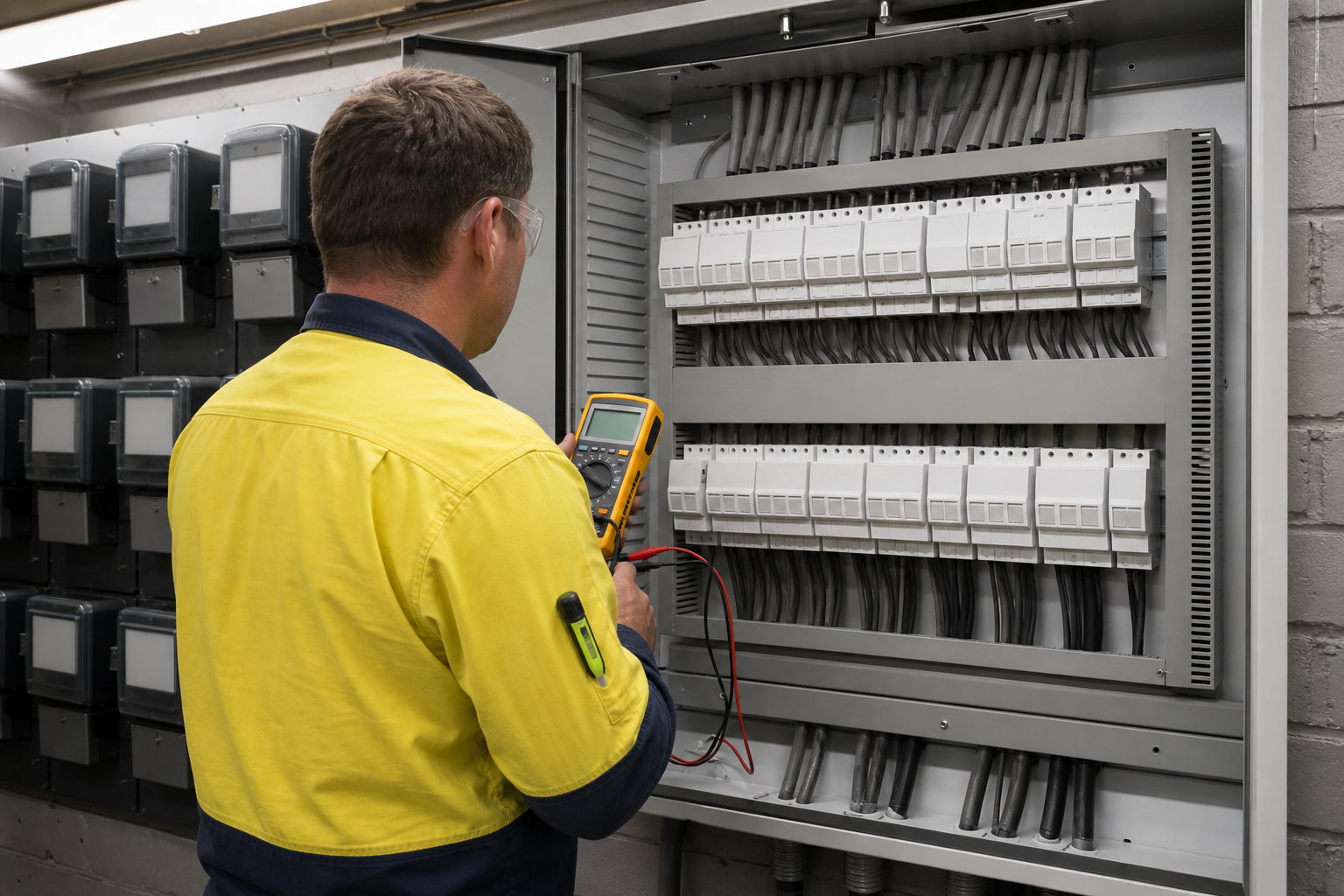
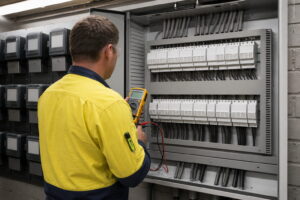
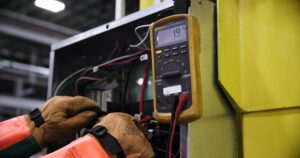
A strata electrician handles electrical work on common property and on infrastructure serving more than one lot: common-area lighting, shared switchboards, fault-finding, safety switches, exit and emergency lighting, and preventative maintenance.
Who pays depends on a rule that is simpler than most people expect. Under the NSW common property memorandum, electrical installations serving more than one lot are generally the owners corporation’s responsibility, and installations serving only one lot and located in non-common-property walls are generally the lot owner’s responsibility. The strata plan and any special by-laws can change that, so they should be checked before responsibility is assigned.
This article is general guidance, not legal advice.
What Property Managers Need to Know
- Six months is the emergency lighting interval. AS/NZS 2293.2:2019 requires routine servicing, including a discharge test, and that the system remain illuminated for at least 90 minutes. This is the number most managers are looking for.
- The Annual Fire Safety Statement is the legal obligation. Emergency lighting and exit signs are statutory fire safety measures in NSW. The AFSS is what proves they meet the standards on your fire safety schedule.
- “Serves more than one lot” is the test for who pays. It resolves most disputes before they start.
- The section 106 claim window is now six years, not two. Changed on 1 July 2025. Deferred common property repairs carry a longer tail of liability than they did in the past.
- Type AC safety switches have been banned since May 2023. If a switchboard still has them, they cannot be lawfully reinstalled, and there are fines associated with it.
- Get itemised quotes. Labour, materials, access equipment, testing, documentation, exclusions and GST, separately. That is what a committee can actually approve.
In This Guide
- What a strata electrician is responsible for
- When to call, and how urgently
- Owner or owners corporation: who pays
- How often emergency lighting must be tested
- Safety switches and the Type AC ban
- Common electrical problems in strata buildings
- Why planned maintenance pays
- Choosing a strata electrician
- What it costs
- What to have ready before you call
- Frequently asked questions
What a Strata Electrician Is Responsible For
A strata electrician carries out electrical work on common property and shared infrastructure. Scope varies by building and by-law, and some work needs a specialist fire-safety contractor or a registered cabler alongside the electrician.
Typical strata electrical services in Sydney cover:
- Common-area lighting in lobbies, hallways and stairwells
- Shared switchboards and distribution boards
- Fault-finding across common infrastructure
- Safety switch installation, testing and replacement
- Power points in shared areas
- Car park and basement lighting
- Intercom and access-control power supplies
- Exit and emergency lighting
- Electrical coordination with smoke alarms and fire systems
- Shared cabling and communications infrastructure
- Surge protection for common systems
- EV charger infrastructure in shared car parks
- Preventative maintenance across common-area assets
When to Call, and How Urgently
Not every electrical fault is an emergency, and treating them all as one is expensive. The distinction is between a safety risk and the loss of an essential system.
Call immediately for
- Smoke, sparks or a burning smell from wiring or switchboards
- Exposed or visibly damaged wiring
- Water near electrical equipment
- A switchboard tripping repeatedly
- Loss of power across common areas or multiple lots
- Switchboard components that are hot to touch or buzzing
- Failed emergency or exit lighting
- Electric shocks or tingling from switches or fittings
- Electrical damage after a storm, leak or flood
Do not touch damaged equipment. Isolate the area only if it is safe to do so. If there is a fire or immediate threat to life, call Triple Zero first.
Schedule as planned work:
- Flickering common-area lights
- Fittings that fail repeatedly
- Unreliable sensors or timers
- Switchboard upgrades
- Energy-efficiency lighting improvements
- Additional power points in shared areas
- New or upgraded data cabling
- Preventative inspections
One point on licensing. In NSW you must hold an electrical licence before undertaking any electrical wiring work, regardless of the cost or type of the job. There is no low-value exemption. Licensing is administered by Building Commission NSW, and you can check any contractor’s licence at verify.licence.nsw.gov.au. Our own is NSW Lic No. 342083C. For more on when a licence is required, see our guide to whether you need a licensed electrician.
Owner or Owners Corporation: Who Pays
Under section 106 of the Strata Schemes Management Act 2015, an owners corporation must properly maintain and keep in a state of good and serviceable repair the common property, and must renew or replace fixtures and fittings comprised in it.
The NSW common property memorandum then sets out the practical split. The organising principle runs through every electrical entry: serves more than one lot, owners corporation; serves only that lot and sits in a non-common-property wall, lot owner.
| Electrical item | Usually owners corporation | Usually lot owner |
|---|---|---|
| Electrical wiring serving more than one lot | Yes | |
| Light fittings serving more than one lot | Yes | |
| Power point sockets serving more than one lot | Yes | |
| Fuses and fuse board in the meter room | Yes | |
| Intercom handset and wiring serving more than one lot | Yes | |
| Smoke detectors, whether or not connected to the fire board | Yes | |
| Air conditioning serving more than one lot | Yes | |
| Wiring in non-common-property walls serving only that lot | Yes | |
| Light fittings, switches and power points inside the lot serving only that lot | Yes | |
| Fuses and fuse board within the lot serving only that lot | Yes | |
| Intercom handset serving one lot, wiring in non-common walls | Yes | |
| Owner-installed equipment | Yes | |
| System altered under a special by-law | Check the by-law | Check the by-law |
Two qualifications that matter.
- The memorandum is not automatically binding. It is prescribed under section 107 of the Act, but it applies to a scheme only if the by-laws adopt it. Where they do not, the strata plan and existing by-laws govern. Either way it cannot override the section 106 duty.
- The claim window has doubled. A lot owner can recover reasonably foreseeable loss from the owners corporation as damages for breach of the section 106 duty. That limitation period was extended from two years to six years, effective 1 July 2025. Deferred common property repairs now carry a considerably longer tail of liability, which is worth raising with committees that habitually defer electrical work.
Where the work turns out to be a lot owner’s responsibility, residential electrical services may be the more appropriate engagement.
How Often Emergency Lighting Must Be Tested
Six months. Emergency and exit lighting requires routine service at six-monthly intervals under AS/NZS 2293.2:2019, including a discharge test in which the system must remain illuminated for at least 90 minutes. Annual service adds cleaning of light-emitting and reflective surfaces. Records must be kept.
The legal mechanism is worth understanding, because it is where managers most often get confused.
- Emergency lighting and exit signs are statutory fire safety measures in NSW, listed in the fire safety schedule for the building.
- The schedule names the minimum standard of performance, which for these measures is AS 2293.
- The Annual Fire Safety Statement is the statutory obligation. The owner, or someone on their behalf, must give it to council within 12 months of the previous statement, provide a copy to the Fire Commissioner, and display it prominently in the building. An accredited practitioner must assess each measure as capable of performing to the standard in the schedule.
- Measures marked as critical in the schedule require statements more often than annually.
So the six-monthly interval is the standard’s requirement, and the AFSS is the annual proof that it has been met. Councils issue penalty infringements for late lodgement, escalating with the delay.
Emergency-lighting maintenance covers functional testing of exit and emergency lights, the discharge test, replacing failed lamps, batteries and fittings, checking exit-sign visibility, keeping records, and coordinating with fire-safety practitioners.
Fire and Rescue NSW’s Fire Safety Compliance Unit enforces statutory fire safety in existing buildings. Its staff inspect buildings, determine whether fire safety provision is adequate, and can issue a fire safety order to the owner. It works almost exclusively with the relevant council. Note it is an enforcement body rather than the lodgement point for statements.
Safety Switches and the Type AC Ban
Anyone specifying safety switch installation in Sydney for a strata building should know that Type AC RCDs were banned in May 2023.
The ban came through Amendment 2 to AS/NZS 3000:2018, the Wiring Rules. Type AC devices do not adequately detect pulsating DC faults, which modern equipment produces. They have been removed from the NSW declared articles list and can no longer be sold or purchased in the state. Type A or Type B must be used instead. Type B is required where DC leakage risk is higher, such as EV chargers and solar inverters.
This is enforced, not advisory. Fines of up to $1,000 apply under section 34(a) of the Gas and Electricity (Consumer Safety) Act 2017, and Building Commission NSW has issued more than $20,000 in penalties since the ban began.
For a strata manager, the practical implication is straightforward: if a switchboard assessment identifies Type AC devices, they cannot lawfully be reinstalled, and replacement should be planned rather than deferred.
Common Electrical Problems in Strata Buildings
Shared systems get used constantly and are often exposed to weather, so the same faults recur across buildings.
- Failed stairwell, hallway or car park lighting. Affects visibility and security. The electrician inspects the fitting, wiring and any sensor or timer on the circuit.
- Ageing switchboards. Repeated trips, or a board identified during other work. Older boards may lack current safety features or capacity for modern loads.
- Overloaded shared circuits. Dimming lights or nuisance trips when several devices run at once. Repeated overloading causes heating and needs load assessment.
- Nuisance tripping. A device tripping repeatedly indicates a fault. The circuit needs tracing rather than resetting, and may need to stay isolated until the cause is found.
- Water ingress. Dampness or corrosion near electrical equipment is a safety hazard and usually requires isolation until assessed.
- Faulty sensors and timers. Lights staying on, failing to activate, or switching off too early. A performance and energy-cost issue rather than an emergency.
- Damaged outdoor fittings. Cracked housings and corroded enclosures allow moisture to enter electrical components.
- Intercom and access-system faults. Affects building access. The electrician checks the supply; the hardware itself may need a specialist.
- Meter-room problems. Damaged components, poor labelling or restricted access.
- Emergency-lighting defects. A failed lamp, flat battery or unlit exit sign, usually found during a scheduled test. Carries fire-safety implications as well as safety ones.
- Insufficient capacity for EV chargers. Committees increasingly need to know whether existing infrastructure supports EV charging. This requires an assessment of available capacity, switchboard infrastructure, and the proposed load before installation.
- Unauthorised alterations. Undocumented work found during unrelated inspections, creating safety and by-law issues.
- Poorly documented wiring. Older buildings with limited records make fault-finding slower and more expensive every time.
For buildings with ageing communications infrastructure, data cabling for strata buildings covers backbone fibre and Cat6A upgrades and equipment room cabling.
Why Planned Maintenance Pays
Planned electrical maintenance finds defects before they become outages, reduces reactive callouts, and gives committees a documented history of the building’s condition. It also makes budget forecasting possible, which matters more now that the section 106 claim window runs to six years.
| Frequency | Activity | Note |
|---|---|---|
| Six-monthly | Emergency and exit lighting service and discharge test | Required under AS/NZS 2293.2 |
| Annually | Emergency lighting clean and service, AFSS lodgement | AFSS is the statutory obligation |
| Scheduled | Switchboard, sensor, timer and exterior fitting assessment | Set the scope for the specific building |
| Routine | Visual review of common-area lighting and accessible equipment | Frequency reflects building use and risk |
| As required | Investigation of tripping, heat, buzzing or intermittent faults | Do not wait for the next scheduled visit |
| After an incident | Assessment following flood, fire, storm or physical damage | Isolate unsafe areas |
| Before upgrades | Load and capacity assessment | Essential before EV chargers or major shared equipment |
Outside emergency lighting, there is no single mandatory inspection interval for every strata building. The right program reflects the building’s age, use, infrastructure and identified risks. A strata electrician working across a portfolio can help a committee set a schedule that fits the building rather than applying a generic one, and can structure it around the strata budget cycle.
Choosing a Strata Electrician
Look for:
- Current NSW electrical licence, verifiable at verify.licence.nsw.gov.au
- Public liability and workers compensation insurance
- Experience in occupied strata buildings
- Itemised quotations a committee can approve
- Defect reporting and compliance documentation
- A defined process for coordinating resident access
- Planned maintenance capability, not only reactive callouts
- Familiarity with common-property boundaries and strata terminology
Questions worth asking:
- Do you regularly work with strata managers and owners corporations?
- Who communicates updates during a job?
- Will the report distinguish urgent defects from planned recommendations?
- Can you provide itemised quotes suitable for committee approval?
- How are after-hours callouts handled, and at what rate?
- How do you coordinate access across multiple lots?
- Which parts of the scope need other specialist contractors?
Red flags: vague or unitemised pricing, no licence details, inconsistent reporting, pressure to approve unexplained work, no process for resident access, and no distinction between urgent and optional work.
Where a building needs broader facilities or fit-out work alongside strata maintenance, check whether the provider also handles commercial electrical services in Sydney.
What It Costs
There is no universal price for strata electrical work. Cost depends on callout timing, labour duration, how many electricians are needed, fault-finding complexity, site access and parking, whether elevated work equipment is required, materials, building size, the number of affected lots, switchboard condition, and testing and reporting requirements.
| Cost component | How it is usually charged |
|---|---|
| Attendance or callout | Fixed fee or minimum charge |
| Labour | Hourly rate or quoted scope |
| After-hours response | Higher emergency rate |
| Materials | Itemised separately or in a fixed quote |
| Access equipment | Additional project cost |
| Testing and reporting | Included or separately itemised |
| Planned maintenance | Per visit, fixed schedule, or service agreement |
| Major upgrade | Quoted site-specifically |
Ask for an itemised quote covering labour, materials, access equipment, testing, documentation, exclusions and GST before approving work. That is what makes a quote presentable to a committee and what stops scope appearing after the job starts.
What to Have Ready Before You Call
Good information helps an electrician triage the job and arrive with the right equipment. It does not replace an on-site assessment where safety is uncertain.
- Building address and access instructions
- Strata plan number or internal job reference
- Exact location of the affected area
- Number of lots or areas affected
- Photos or video, where safe to take them
- When the fault started
- Whether breakers are currently tripping
- Any signs of smoke, heat, water or burning smell
- Previous repair history for the equipment
- On-site contact for access
- Parking or loading restrictions
- Committee or spending approval limits
- Resident notification requirements
Frequently Asked Questions
What does a strata electrician do?
A strata electrician carries out electrical work on common property and on infrastructure serving multiple lots: shared switchboards, common-area lighting, fault-finding, inspections, repairs, preventative maintenance and emergency attendance. Scope varies by building and by-law, so the specific installation and responsibility should be confirmed before work begins.
How often does emergency lighting need testing in a strata building?
Every six months, under AS/NZS 2293.2:2019. The six-monthly service includes a discharge test in which the system must remain illuminated for at least 90 minutes. Annual service adds cleaning of light-emitting and reflective surfaces. Separately, the Annual Fire Safety Statement must be given to council each year, with a copy to the Fire Commissioner and a copy displayed in the building.
Who pays for electrical repairs in a strata building, the owner or the owners corporation?
Generally, installations serving more than one lot are the owners corporation’s responsibility, and installations serving only one lot and located in non-common-property walls are the lot owner’s. Section 106 of the Strata Schemes Management Act 2015 imposes the maintenance duty on the owners corporation for common property. The strata plan, adopted common property memorandum and any special by-laws should be checked, since they can change the allocation.
Can Type AC safety switches still be used in NSW?
No. Type AC RCDs were banned in May 2023 under Amendment 2 to AS/NZS 3000:2018, and removed from the NSW declared articles list, so they can no longer be sold or purchased in the state. Type A or Type B devices must be used instead, with Type B required where DC leakage risk is higher, such as EV chargers and solar inverters. Fines of up to $1,000 apply.
How much does a strata electrician cost in Sydney?
There is no standard price. Cost depends on callout timing, labour, fault-finding complexity, site access, materials, testing and reporting, and whether the work is planned or after-hours. Request an itemised, site-specific quote covering labour, materials, access equipment, testing, documentation, exclusions and GST before approving the job.
Does a strata electrician provide emergency electrical services?
Availability depends on the contractor’s after-hours arrangements. Urgent situations include common-area power failures, exposed wiring, burning smells, water near electrical equipment, and switchboards that keep tripping. Confirm a contractor’s emergency response arrangements before an urgent fault occurs, not during one.
Talk to Us About Your Building
Monaco Electrical has worked with Sydney strata managers and owners corporations for over 25 years, across more than 500 strata jobs. We are licensed and fully insured, NSW Lic No. 342083C, with public liability and workers compensation on every job. Exit and emergency lighting is tested to AS 2293 with full compliance documentation.
Quotes are free, itemised and suitable for committee approval, and we respond within two business hours.
Call 1300 092 853 or arrange a strata electrical assessment. Have your building details, affected areas, access requirements and any relevant documentation ready, and we can scope the work and quote it properly.
References
- Strata Schemes Management Act 2015, NSW Legislation
- Common property memorandum, NSW Government
- Residual current device compliance, NSW Government
- Electricians: licensing and compliance, NSW Government
- Verify.Licence, NSW Government
- Fire Safety Compliance Unit, Fire and Rescue NSW
- Fire safety certification, NSW Department of Planning